USMCA Certificate of Origin Template (Certification of Origin)
Fill in the certifier, the parties and the goods to get a USMCA / CUSMA certification of origin with the required statement.
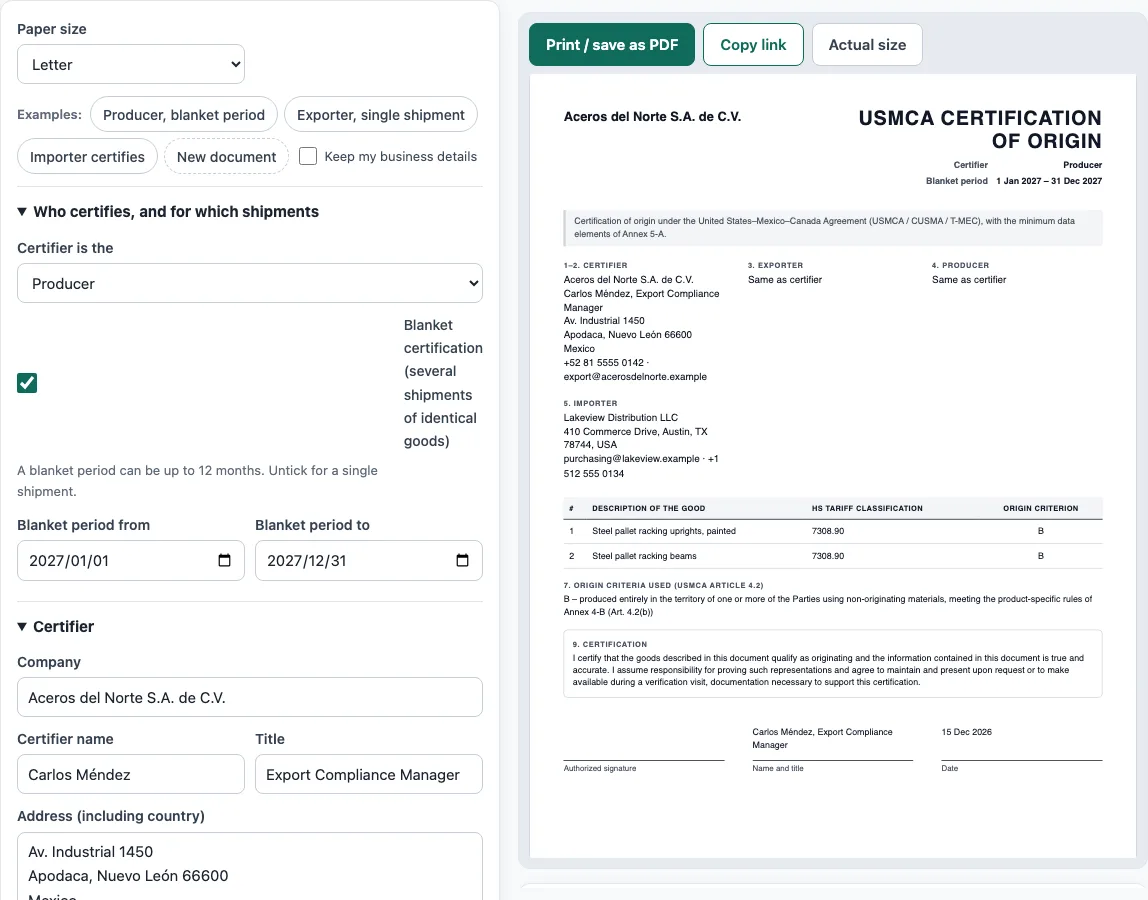
How to use the USMCA certification of origin template
- Click an ‘Examples:’ button such as ‘Producer, blanket period’ to see a filled-in document, or ‘New document’ to start blank.
- In ‘Who certifies, and for which shipments’, set ‘Certifier is the’ to Exporter, Producer or Importer.
- Decide on the shipments. Tick ‘Blanket certification (several shipments of identical goods)’ and enter ‘Blanket period from’ and ‘Blanket period to’ for up to 12 months. For a single shipment, untick it and add the ‘Invoice number (single shipment)’ if you know it.
- In ‘Certifier’, fill in Company, Certifier name, Title, Address (including country), Phone and Email.
- In ‘Exporter, producer and importer’, tick ‘The exporter is the certifier’ or enter the Exporter, then choose an option for ‘Producer’. Add the ‘Importer (if known)’.
- In ‘Goods: description, HS code, origin criterion’, click ‘Add item’ for each good. Enter the description, the six-digit HS code and the origin criterion.
- In ‘Signature and date’, enter the ‘Name of the person signing’ and the ‘Date signed’.
- Read the warnings under the preview and fix any that appear. Then check the result lines: ‘Goods listed’, ‘Blanket period length’, ‘Latest end date for this blanket period’ and ‘Accepted by customs until (4 years after signing)’.
Click ‘Print / save as PDF’ to print only the document, then choose Save as PDF in the browser’s print dialog. ‘Copy link’ copies a link that holds the whole document. Your draft stays in this browser.
What does a USMCA certification of origin need to include?
A USMCA certification of origin must contain the nine minimum data elements listed in Annex 5-A of the agreement. These cover who certifies, the names and contact details of the certifier, exporter, producer and importer, a description of each good with its six-digit HS code, the origin criterion, any blanket period, and the signed and dated certification statement.
Is there an official USMCA certification of origin template?
No. The agreement does not prescribe a form (Article 5.2.3). The certification can sit on an invoice or any other document, as long as it contains the minimum data elements. CBP says the old NAFTA CBP Form 434 is no longer in use or accepted. A template is only a layout for those elements.
What are the origin criteria A, B, C and D?
Article 4.2 sets out four ways a good can be originating, in subparagraphs (a) to (d); certifications usually write them as the letters A to D. A means wholly obtained or produced entirely in USMCA countries. B means produced using non-originating materials that meet the product-specific rules in Annex 4-B. C means produced entirely in USMCA countries using only originating materials. D means produced in USMCA countries where parts cannot meet the tariff-shift rule, with a regional value content of at least 60 % (transaction value) or 50 % (net cost). Criterion D does not apply to HS chapters 61 to 63, which cover textiles and apparel.
How long can a USMCA blanket period run?
A blanket period covers several shipments of identical goods for up to 12 months (Article 5.3.5). Customs accept a certification for four years after the date it was completed (Article 5.3.6). The tool warns you if a blanket period runs past that four-year limit.
Who can complete a USMCA certification, and in what language?
The importer, exporter or producer can complete it. It may be written in English, French or Spanish, and it may be signed electronically. The signature must be accompanied by a set statement that begins “I certify that the goods described in this document qualify as originating and the information contained in this document is true and accurate.” The tool checks the data elements and dates, but whether the goods qualify depends on the rules of origin for each HS code.
Sources
- USMCA Chapter 5, Origin Procedures (USTR) — Article 5.2 (no prescribed format), Article 5.3 (blanket period up to 12 months, accepted for four years) and Annex 5-A (the nine minimum data elements and the certification statement, printed word for word).
- USMCA Chapter 4, Rules of Origin (USTR) — Article 4.2 (a) to (d), the origin criteria A to D.
- CBP, USMCA FAQs — no required form; CBP Form 434 no longer used. Checked October 2026.
Worked examples
| Input | Result |
|---|---|
| Goods lines: 2; certified by the producer | Blanket period of 365 days; accepted until 15 Dec 2030 |
| Goods lines: 1; certified by the exporter | Single shipment; accepted until 12 Oct 2030 |
| Goods lines: 2; certified by the importer | Blanket period of 181 days; accepted until 12 Oct 2030 |
Calculated by the tool above with these values.
Frequently asked questions
Is a CUSMA certificate of origin template the same as a USMCA template?
Yes. CUSMA is the Canadian name for the same agreement, and T-MEC is the Mexican name. A template built to the USMCA data elements works for all three names.
Do I need CBP Form 434 with this template?
No. CBP says the NAFTA-era Form 434 is no longer in use or accepted. A USMCA certification can be any document that contains the minimum data elements.
Can I use this template for a single shipment?
Yes. Untick ‘Blanket certification (several shipments of identical goods)’ and add the invoice number if you know it.
Does the tool confirm that my goods qualify for the USMCA rate?
No. The tool checks the required data elements and the dates. Whether a good qualifies depends on the rules of origin for its HS code, which you need to confirm yourself.
Can the certification be signed electronically?
Yes. USMCA Article 5.2 lets a certification of origin be completed and submitted electronically with an electronic or digital signature. You can also print it and sign by hand.
How long is a USMCA certification valid?
Customs accept it for four years after the date it was completed (Article 5.3.6). The result line ‘Accepted by customs until’ shows that date for your Date signed.
Related tools
- Certificate of origin template — the exporter’s origin declaration for a chamber to certify.
- Commercial invoice template — the customs invoice for an international shipment.
- Packing list template — cartons, weights and CBM, package by package.
- Proforma invoice template — the pre-shipment invoice with Incoterms, ports and HS codes.
- Bill of lading template — a straight bill of lading for truck shipments.
- Invoice generator — invoices with tax, discounts, shipping, payments and balance due.