Bill of Lading Template (Straight BOL Form)
Enter the shipment details and lines; the straight bill of lading totals the units and weight and is ready to print and sign.
How to use the Bill of Lading Template
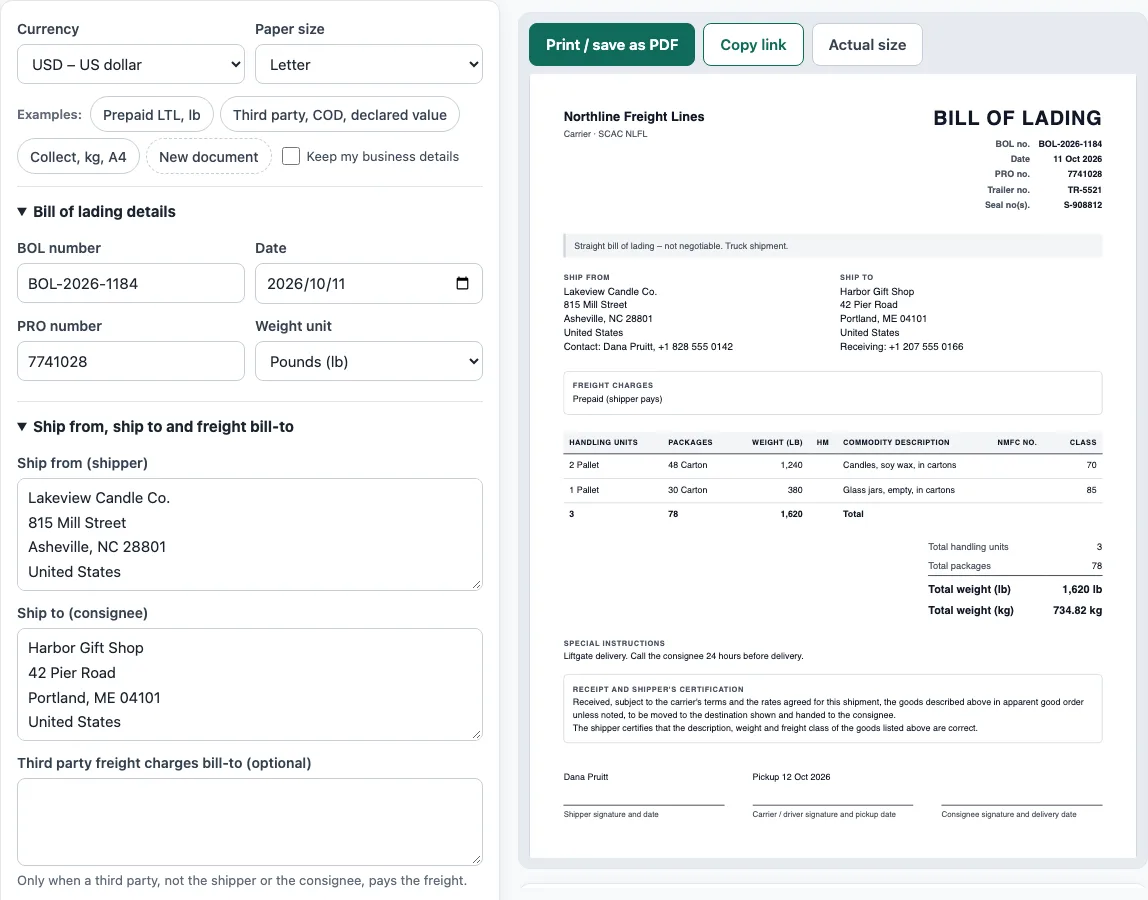
- In Bill of lading details, enter the BOL number and the date. Add a PRO number if the carrier has given you one.
- In Ship from, ship to and freight bill-to, enter the Ship from (shipper) and Ship to (consignee) details. Fill in the third party freight charges bill-to only if someone other than the shipper or consignee pays the freight.
- In Carrier and freight terms, enter the Carrier name, and the SCAC if you have it. Add the Trailer no. and Seal no(s). Then choose Freight charges: Prepaid, Collect or Third party.
- In Goods, choose your Weight unit and click Add item for each line. For each row, enter the handling units and type, the packages and package type, the line weight, the HM choice, the commodity description, the NMFC no. and the freight class.
- In Instructions, COD, declared value and signatures, add any special instructions, the COD amount and COD fee terms if they apply, and the declared value. Then enter the shipper’s name and the pickup date.
- Check the live preview and the warnings below it. Fix anything flagged before you print.
- Click Print / save as PDF, then choose Save as PDF in the browser’s print dialog.
What does a bill of lading do?
A bill of lading is the carrier’s written receipt for goods it has taken in for shipment. It lists what was received, how many units and how heavy, and it serves as evidence of the contract of carriage between the shipper and the carrier. The carrier signs for what the document says it received, so every count and weight should match the goods physically on the truck.
What is a straight bill of lading, and what does each line need?
A straight bill of lading is non-negotiable: the goods are consigned to a named consignee and cannot be transferred by endorsement. It is the usual form for domestic truck shipments in the US, both less-than-truckload (LTL) and full truckload. Ocean bills of lading are different. They are issued by the shipping line or NVOCC and can be documents of title, so this tool does not produce them.
Each line of goods should be counted, weighed and described exactly. The NMFC freight class is one of 18 classes from 50 to 500. Since the NMFC changes that took effect in July 2025 (Docket 2025-1), most classes are based mainly on density, with handling, stowability and liability also taken into account, and the class affects the LTL rate. Look up the item in the current NMFC from the NMFTA. A wrong class is re-billed, so check it against the goods before you print. If a line is hazardous, mark it HM. This form only marks the line. Hazardous materials also need full shipping papers with the proper shipping name, hazard class, UN number and an emergency response phone number (49 CFR part 172, subpart C). This tool is not a dangerous goods declaration.
What do the freight terms on a bill of lading mean?
Freight terms say who pays the carrier. Prepaid means the shipper pays the freight charges. Collect means the consignee pays on delivery. Third party means someone else, often the buyer’s or seller’s logistics provider, receives the freight bill; enter that party in the third-party bill-to section so the carrier knows where to send the invoice.
Sources
- NMFTA — the National Motor Freight Classification (18 classes, 50–500; density-based changes from Docket 2025-1, July 2025).
- 49 CFR part 172, subpart C — hazardous materials shipping papers.
- Unit conversions: 1 lb = 0.45359237 kg exactly and 1 in = 2.54 cm exactly (NIST SP 811, Appendix B).
Worked examples
| Input | Result |
|---|---|
| 2 lines, freight Prepaid (shipper pays) | 3 handling units, 1,620 lb (734.82 kg) |
| 1 lines, freight Third party (bill to the party shown) | 4 handling units, 2,860 lb (1,297.274 kg) |
| 1 lines, freight Collect (consignee pays) | 6 handling units, 6,944.561 lb (3,150 kg) |
Calculated by the tool above with these values.
Frequently asked questions
Is this bill of lading template free to use?
Yes. It is free, needs no account or sign-up, and documents made here may be used for business with no attribution.
Where can I find a bill of lading sample or example?
Click one of the Examples buttons above the form: Prepaid LTL, lb; Third party, COD, declared value; or Collect, kg, A4. The form fills with a sample document that you can change to suit your shipment.
How do I start a blank bill of lading?
Click New document to clear the form. Tick Keep my business details first if you want your company details kept.
Can I save this bill of lading form as a PDF?
Yes. Click Print / save as PDF, then choose Save as PDF in the browser’s print dialog. Only the document prints, not the rest of the page.
Is my information stored or uploaded?
Everything runs in your browser, and nothing you type is uploaded. The draft is saved in this browser as you type, and nothing is stored on a server.
Can this bol template replace hazmat shipping papers?
No. The HM mark on this form does not replace the full shipping papers that hazardous materials require, which must include the proper shipping name, hazard class, UN/NA number, packing group and an emergency contact.
Related tools
- Packing list template — cartons, weights and CBM, package by package.
- Shipping label generator — address labels for boxes and pallets, numbered 1 of N.
- Commercial invoice template — the customs invoice for an international shipment.
- Delivery note template — what was delivered, for the customer to sign.
- Certificate of origin template — the exporter’s origin declaration for a chamber to certify.
- Invoice generator — invoices with tax, discounts, shipping, payments and balance due.
- Delivery order template — the D/O that releases cargo from a terminal or warehouse.